Remember everything.
Maintain nothing.
Your life scatters across emails, calendars, and promises. Lifewoven connects it, notices what matters, and surfaces it before you ask.
Your life is already being written — in your email, your calendar, your promises. Most of it is being lost.
Three minutes. A film about what it looks like to remember everything.
How it works
-
Connect
One sign-in — Google or Outlook. That’s the whole setup.
Your email, calendar, and contacts — read, connected, and kept current.
-
Birth
About ten minutes later, your personal memory is ready.
Your people, projects, and promises, compiled into private pages. It weaves as far back as you let it — a few months gives you a sketch, years give you the connections nobody could hold in their head.
-
The Reveal
Your life, finally in one place — and connected.
The dinner, the promise, the person who made it — every thread linked.
-
Daily Life
It’s less like an app, more like someone who remembers.
Talk to it, type to it, or send it a photo or a document — it files everything into your life. Call it and talk like you would a friend, interrupting mid-sentence and all. Drop in a whole meeting and it keeps the decisions, not just the words. However life reaches you, it reaches your second brain — and every answer, in text or out loud, shows the source it came from.
A look inside
A demo brain — Daniel, from our film. Not a real user.
-
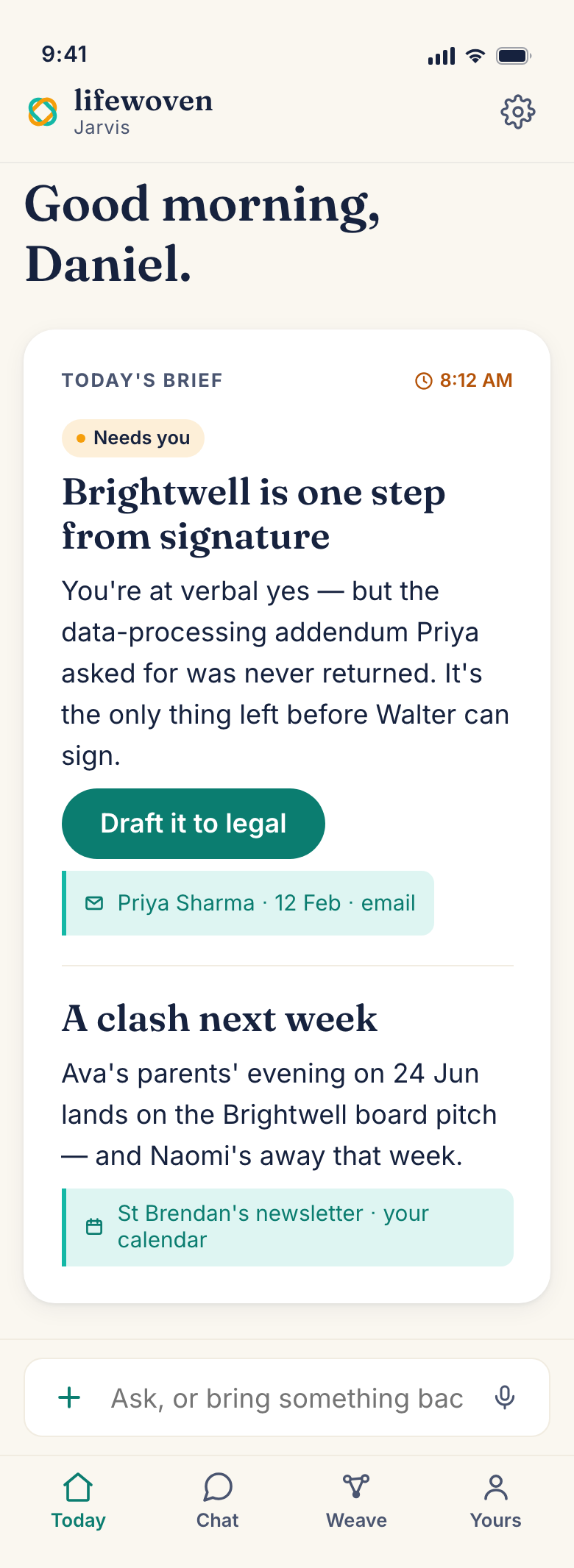
Today -
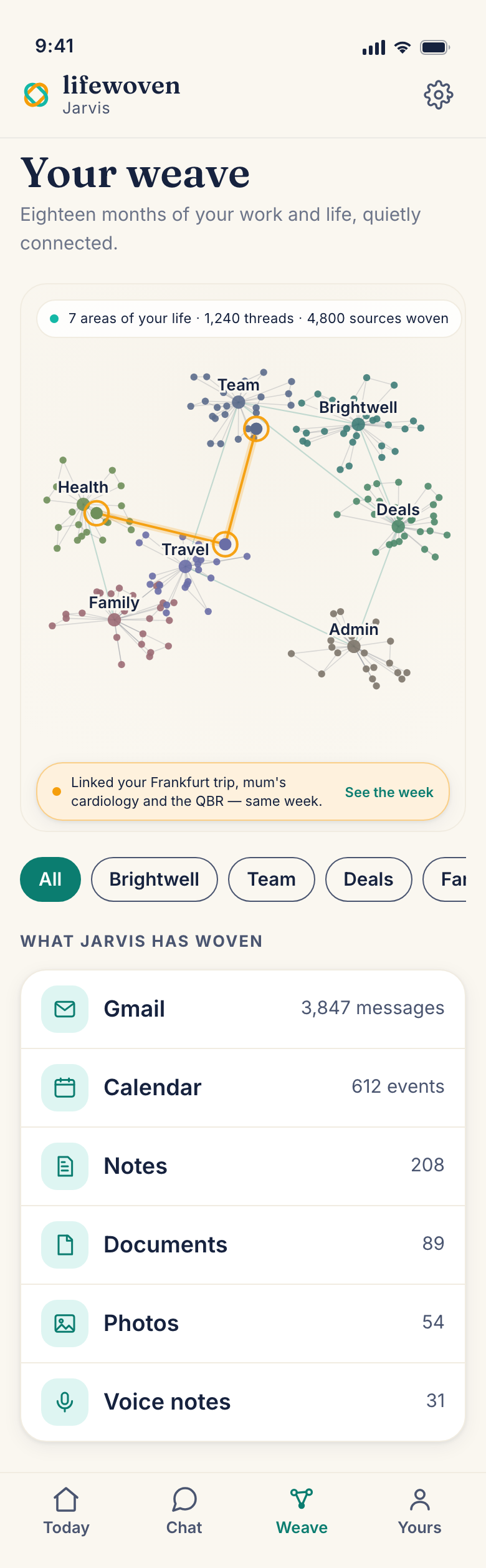
Weave -

Chat -

Yours


Each screen scrolls.
Why everything else failed
Sticky notes, screenshots, starred emails, reminder apps — every system works until it becomes one more thing to maintain. So it gets abandoned, somewhere between week two and week six.
- The screenshot you never found again.
- The reminder app that became noise.
- The system you abandoned in January.
What is different now is that the filing is not yours to do.
Someone has always done this job
Remembering on another person’s behalf is real work, and it has always been done by a person. Chiefs of staff. Executive assistants. The one colleague who has been there long enough to know.
It was never a technology problem. It was a payroll problem.
Now it doesn’t have to be a person.
From the film
Seven lives we imagined — characters from our film, not customers.


The honest part
The engine behind Lifewoven has quietly run its founder’s life for months — 700+ pages compiled from 32,000+ emails going back 19 years, plus his calendar, finances, and health data, with a brief every morning. It is still compounding: its own nightly audit adds around six new pages a day. The app opens to a small founding circle in September 2026.
The more it knows, the more it sees.
Lifewoven remembers what you tell it and what you write. With your permission it also reads the signals you already generate — your sleep, your training, your heart rate from the watch or ring you already wear. Not to track you, but to connect the dots only you would care about — why last week felt heavy, which meetings drain you, how your body and your life actually move together.
And further out, the machines arriving in our lives — the assistant in the home, the car that drives itself, the devices that fill a house — will each work better for knowing you.
They won’t carry your memory. Lifewoven will. Your life, connected for you alone, becomes the memory every one of them can plug into.
What it is, and what it does with your life
The eight questions worth asking before you connect anything.
How is a second brain different from a note-taking app?
Lifewoven builds itself from your mail, calendar and contacts, and takes anything else you give it, in any form.
- Voice notes, photos, documents, a zipped folder, or plain conversation — nothing to convert, nowhere to file it.
- It reads what is missing, not only what is there: promises with nothing behind them, people gone quiet, projects stalled, links across parts of your life you keep apart.
- It tells you what to do about each, with the source. The deeper you let it go, the more it sees.
Can Lifewoven read my email?
Only if you tick a box, and only to read — never to send, edit or delete.
- The checkbox starts unticked. Leave it, and Lifewoven never sees a message.
- It starts with a recent window and goes deeper only when you ask it to.
- Promotions and social notifications are excluded. Newsletters and receipts stay unread: sender and date only.
Where is my data stored?
On an encrypted volume in the European Union, in a directory that is yours alone.
- Nothing outside your own directory is reachable.
- Backups are encrypted before they leave and held in the European Union, off the public internet.
- The limit: the volume key sits on the same system, so encryption protects a stolen disk, not a hijacked one.
Do you train AI models on my data?
No — Lifewoven trains nothing, and Google is contractually barred from training on your content.
- Gemini runs on a paid tier, whose terms exclude your prompts from training.
- One caveat: Google keeps short-lived abuse-detection logs, and no setting turns them off.
How do I delete everything, and can I export it?
Both — export downloads your whole weave, deletion removes it, and either takes about a minute.
- Deletion is a typed confirmation, and it takes pages, mail copies, chats and captures.
- Your Google permission is handed back in the same operation.
- Encrypted backups age out within thirty days.
How much does it cost?
The price is not set yet, and Lifewoven is paid software with no free tier.
- No advertising, and we never sell or share what is in your brain.
- The number will be published before anyone is asked to commit.
What happens if Lifewoven shuts down?
You can export everything and delete everything, at any time, without asking us.
- Neither depends on us being available.
- If Lifewoven is ever acquired, we will tell you before it happens.
What happens after I give you my email address?
We keep the address, write to you once when the circle opens, and nothing else.
- Joining grants no access to your mailbox. Nothing is connected until you sign in.
- Your address is not sold, shared, or added to any other list.
- Ask us to delete it at any time and we will.
Join the founding circle
One hundred places. That is Google’s cap on an app it has not finished verifying — here is why.